
Cervical Spondylosis Pillow: Choosing the Right Pillow for Sleep
If you are looking for a cervical spondylosis pillow, you are probably trying to answer a practical question: what type of pillow can provide comfortable support while you sleep when you have cervical spondylosis?
Cervical spondylosis is an age-related change in the neck that can cause neck pain, stiffness and sometimes pain extending toward the shoulder or arm. Many people with cervical spondylosis have no symptoms, while others experience recurring discomfort.
A pillow does not treat or reverse cervical spondylosis. However, the way your head and neck are positioned during sleep can affect comfort. NHS guidance recommends keeping the head in line with the spine and using a supportive, comfortable pillow; one NHS source specifically advises a low, firm pillow for neck pain.
This is where pillow height, shape and sleeping position become important.
Elevate Pillow is designed with different center and end heights. The center is intended for back sleeping, while the ends are designed for side sleeping in either direction. Its two documented configurations provide different center and end heights.
Pillow for Cervical Spondylosis: Does a Pillow Help?
A pillow for cervical spondylosis should primarily be considered as a sleep-support product, not as a treatment for the underlying condition.
Cervical spondylosis can involve age-related changes in the bones and discs of the neck. It may cause pain, stiffness or headaches, although many people have the condition without symptoms.
During sleep, the goal is to find a comfortable position in which the head and neck are appropriately supported.
Cambridge University Hospitals advises keeping the neck in alignment and well supported while sleeping, with the head positioned in the middle and in line with the spine.
Therefore, when choosing a pillow for cervical spondylosis, consider:
Therefore, when choosing a pillow for cervical spondylosis, consider:
- Your normal sleeping position
- Pillow height
- Neck support
- Head position
- Side-sleeping requirements
- Back-sleeping requirements
- Overall comfort
There is no single pillow that is automatically the best choice for everyone with cervical spondylosis.
Best Cervical Spondylosis Pillow: What Should You Look For?
The best cervical spondylosis pillow should be selected according to your sleeping position and comfort requirements rather than simply by its name.
A useful starting checklist is:
Appropriate Height
The pillow should not force your head into an uncomfortable position.
Neck Support
The pillow should provide a stable and comfortable support area around the neck.
Sleeping Position
A back sleeper and a side sleeper may need different pillow characteristics.
Comfortable Contour
A shaped pillow can provide different support zones, but the contour should feel comfortable rather than simply looking ergonomic.
Suitable Compression
The material should respond appropriately when your head rests on it.
Consistent Design
The dimensions and intended use should be clearly explained.
Best Pillow for Cervical Spondylosis: Why Pillow Height Matters
The best pillow for cervical spondylosis is not necessarily the highest pillow. Height should match the sleeping position and the sleeper’s comfort.
NHS guidance for neck pain recommends a low, firm pillow and advises keeping the head at the same height as the rest of the body while sleeping. Elevate approaches height differently across the pillow.
Elevate Model 1
Model 1
61 cm length
4.5 cm center height
8.5 cm end height
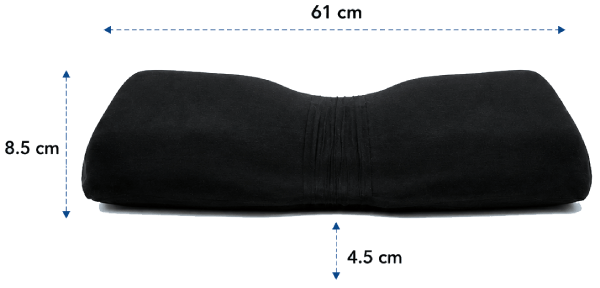
Elevate Model 2
Model 2
61 cm length
2.5 cm center height
6.5 cm end height
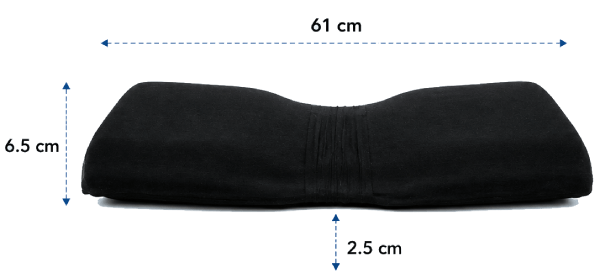
The product information recommends Model 1 for people currently using approximately a 2-inch-height pillow and Model 2 for people who currently use no pillow.
The center and ends are intentionally different because the pillow is designed around different sleeping positions
Neck Pillow for Cervical Spondylosis: Back Sleeping vs Side Sleeping
When choosing a neck pillow for cervical spondylosis, first consider how you normally sleep.
Back Sleeping
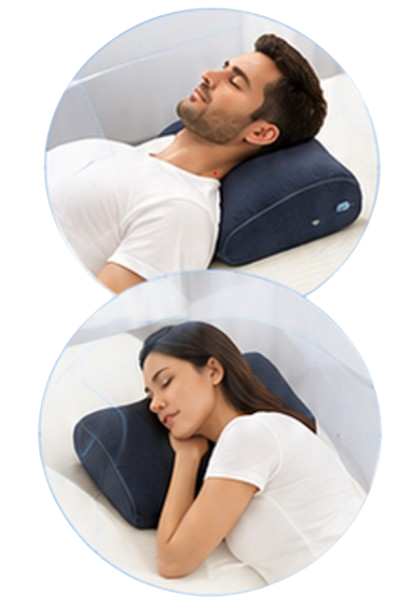
When sleeping on your back, the center of the Elevate Pillow is the intended sleeping area.
The center has a lower height than the ends.
Side Sleeping
When sleeping on your side, the higher end sections are designed for side sleeping.
Elevate has an end on each side, so the pillow can be used for side sleeping in either direction.
This is useful for people who naturally change sleeping positions during the night.
However, comfort is individual. A pillow should not be considered appropriate simply because it is labelled “cervical.”
Neck Pillow for Cervical Spondylosis: Back Sleeping vs Side Sleeping
If you are searching for the best neck pillow for cervical spondylosis, evaluate the pillow according to your sleeping habits.
Ask:
Do I sleep mainly on my back?
Do I sleep mainly on my side?
Do I change positions during sleep?
What pillow height am I currently comfortable with?
Does the pillow keep my head comfortably supported?
Does the contour feel comfortable around my neck?
Does the pillow cause pressure or discomfort?
Elevate’s design provides a lower center and higher ends, with the center intended for back sleeping and the ends intended for side sleeping.
The goal is not to find the pillow with the most dramatic shape.
The goal is to find a pillow that fits your sleeping position and feels comfortable.
Butterfly Pillow for Cervical Spondylosis: Is a Butterfly Shape Better?
A butterfly pillow for cervical spondylosis is a type of shaped pillow designed with a butterfly-like profile and multiple support areas.
The shape itself does not prove that a pillow is better for cervical spondylosis.
When comparing a butterfly design, consider:
- Center height
- Side height
- Neck-support area
- Shoulder clearance
- Sleeping position
- Firmness
- Comfort
A butterfly shaped pillow for cervical spondylosis may suit one person while another person may prefer a different contour.
Elevate uses a different design approach. Rather than relying on a butterfly shape, it uses different center and end heights for different sleeping positions.
Cervical Pillow for Spondylosis: Why Contour Design Matters
A cervical pillow for spondylosis should be evaluated according to how its contour interacts with the sleeper.
A contour can create different support zones by changing:
- Height
- Shape
- Surface profile
- Compression
- Neck-support area
Elevate’s design uses different heights across the pillow.
The center is designed for back sleeping.
The two ends are designed for side sleeping.
The product documentation also describes different compression characteristics in the upper and lower directions.
This means the contour is part of the overall support design rather than simply a visual feature.
Ergonomic Latex Pillow for Cervical Spondylosis: Does Material Matter?
People searching for an ergonomic latex pillow for cervical spondylosis are often comparing materials as well as shapes.
Latex is one pillow material, while memory foam and other foams are alternatives.
But material alone does not determine whether a pillow is appropriate.
You should also compare:
- Height
- Shape
- Contour
- Compression
- Sleeping position
- Comfort
Elevate’s supplied product information lists Softy Foam + Foam rather than latex.
Therefore, Elevate should not be presented as a latex cervical pillow.
Its differentiation comes from its multi-height contour and sleeping-position design, not from latex construction.
Memory Foam Pillow for Cervical Spondylosis: Is Memory Foam Necessary?
A memory foam pillow for cervical spondylosis is another common option people consider.
Memory foam is a material. It does not automatically determine whether the pillow has an appropriate height or contour.
When comparing a memory foam pillow for cervical spondylosis, look at:
- Shape
- Height
- Firmness
- Compression
- Sleeping position
- Neck support
- Comfort
Elevate’s documented construction is Softy Foam + Foam.
The product documentation also describes different compression characteristics in the upper and lower directions.
So the important comparison is not simply:
Memory foam vs foam.
It is:
Which complete pillow design is comfortable and appropriate for your sleeping position?
Neck Pain Cervical Spondylosis Pillow: What About Morning Neck Pain?
A neck pain cervical spondylosis pillow should not be treated as a cure for morning pain.
Cervical spondylosis can cause neck pain and stiffness, and symptoms can vary from person to person.
If you regularly wake with neck discomfort, consider whether:
- Your pillow is too high
- Your pillow is too low
- Your head is tilted during sleep
- You sleep on your stomach
- Your sleeping position is uncomfortable
- Your pillow has lost its shape
- Your mattress and pillow combination feels unsuitable
NHS guidance recommends keeping the head aligned with the spine during sleep.
If pain continues for several weeks, becomes worse or is significantly affecting your daily activities, seek medical advice.
Orthopedic Pillow for Cervical Spondylosis: What Does Orthopedic Mean?
An orthopedic pillow for cervical spondylosis is usually marketed as a pillow designed around anatomical support.
However, the word “orthopedic” alone should not be treated as evidence that a pillow will treat cervical spondylosis.
Look at the actual specifications.
For Elevate, the documented features include:
- Different center and end heights
- Back-sleeping support
- Side-sleeping support
- Side sleeping in both directions
- Ergonomic design
- Different compression characteristics
These are more useful points to evaluate than a marketing label.
Cervical Spondylosis Neck Pillow: How Elevate Is Designed
A cervical spondylosis neck pillow should be selected according to the sleeper’s position and comfort.
Elevate’s design uses three functional areas.
Center
Designed for back sleeping.
Left End
Designed for side sleeping.
Right End
Designed for side sleeping.
The product information specifically describes the center as the back-sleeping section and both ends as side-sleeping sections.
This makes the pillow suitable for consideration by people who alternate between back and side sleeping. It does not mean the pillow treats cervical spondylosis. It means the product is designed to provide structured sleep support.

Cervical Spondylosis Sleep Without Pillow: Is No Pillow Better?
The question “cervical spondylosis sleep without pillow” does not have one universal answer. Some people may prefer sleeping without a pillow, while others are more comfortable with support.
One NHS source recommends a low, firm pillow for neck pain, while another advises keeping the head in the middle and in line with the spine and using one pillow. Elevate specifically provides a lower-height Model 2 for people who currently use no pillow.
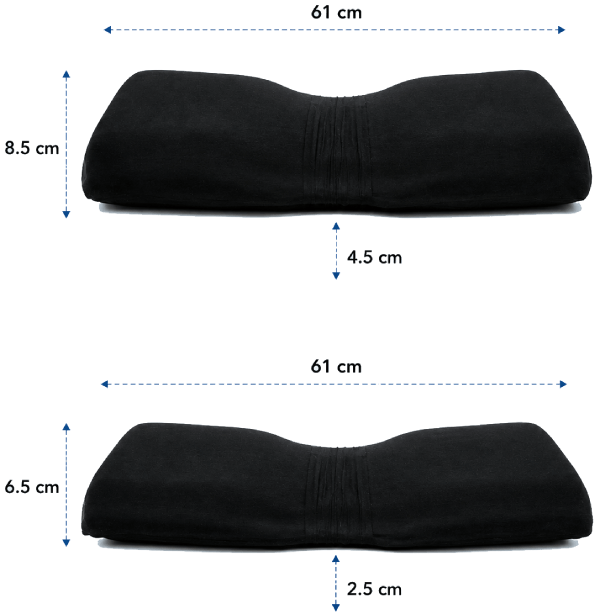
Model 2 has:
2.5 cm center height
6.5 cm end height
61 cm length
The company documentation recommends this model for people who currently use no pillow.
The important point is that you should not assume that no pillow is automatically better for cervical spondylosis. Comfortable alignment and individual needs matter.
Use of Pillow in Cervical Spondylosis: Should You Use One?
The use of pillow in cervical spondylosis depends on the individual’s sleeping position, comfort and symptoms.
There is no universal requirement that every person with cervical spondylosis must use a particular pillow.
NHS guidance for neck pain suggests a low, firm pillow, while Cambridge University Hospitals advises keeping the head in the middle and aligned with the spine and using one pillow.
A practical approach is to assess whether your pillow allows you to sleep comfortably without forcing your head forward, backward or sideways.
If you are changing pillows, give yourself time to assess comfort rather than assuming a new pillow will immediately solve neck symptoms.
Cervical Spondylosis Pillow: Back Sleepers and Pillow Height
For people looking for a cervical spondylosis pillow for back sleeping, the center section is particularly relevant.
Elevate’s center is lower than its ends.
Model 1 has a 4.5 cm center, while Model 2 has a 2.5 cm center.
The center section is intended for back sleeping.
This design means you are not sleeping on the same height throughout the pillow.
For back sleepers, the important consideration is whether the center section feels comfortable and allows the head and neck to remain in a comfortable position.
Cervical Spondylosis Pillow: Side Sleepers and End Height
For side sleepers searching for a cervical spondylosis pillow, the end sections become more important.
Elevate’s ends are higher than its center.
Model 1 has an 8.5 cm end height.
Model 2 has a 6.5 cm end height.
The ends are designed for side sleeping in either direction.
This gives side sleepers a dedicated area rather than requiring the entire pillow to have one uniform height.
Again, this is a design feature, not a medical treatment claim.
Cervical Spondylosis Pillow: What Makes Elevate Different?
The Elevate approach to a cervical spondylosis pillow is based on position-specific design.
The pillow provides:
Different center and end heights
A center for back sleeping
Two ends for side sleeping
Side sleeping support in either direction
Different compression characteristics
An ergonomic design
The supplied product documentation describes the ergonomic design as intended to provide necessary neck support and help maintain spinal alignment during sleep. The product-development documentation also records user feedback that led to changes in the side contour and other design elements.
That makes the design story more specific than simply calling Elevate an “orthopedic” or “cervical” pillow.

Cervical Spondylosis Pillow: How User Feedback Improved the Design
A useful part of the Elevate story is that its design was refined through user feedback.
According to the supplied documentation, an earlier version had a semi-circle side contour. User feedback suggested additional support in this area, after which the company states that the contour was changed to a special support contour. Another user raised concerns about sharp edges, which the company states were subsequently rounded.
This demonstrates an iterative approach:
Design
User Experience
Feedback
Modification
Cervical Spondylosis Pillow: Pillow Design vs Medical Treatment
A cervical spondylosis pillow should be presented accurately. Cervical spondylosis is an age-related condition affecting the neck, and management can involve exercise, physiotherapy, medication and other approaches depending on symptoms. A pillow is only one part of a person’s sleeping environment. Elevate is a sleep-support product.
It should not be described as:
- A cure for cervical spondylosis
- A treatment for cervical arthritis
- A replacement for physiotherapy
- A replacement for prescribed medication
- A way to reverse spinal degeneration
Instead, the product can be described in terms of its design, height, contour and intended sleeping-position support. This distinction is particularly important for health-related search content.
Cervical Spondylosis Pillow: When Should You See a Doctor?
A cervical spondylosis pillow should never delay appropriate medical care.
According to NHS guidance, seek medical advice if neck pain or stiffness does not go away after a few weeks or becomes worse.
More urgent assessment is recommended for symptoms such as severe or rapidly worsening neck pain, arm or leg weakness, or pins and needles associated with neck or arm pain.
Emergency symptoms can include new walking problems, loss of bladder or bowel control, sudden loss of coordination or difficulty speaking.
If you have been diagnosed with cervical spondylosis and your symptoms are persistent or worsening, speak with your doctor or qualified physiotherapist.
Cervical Spondylosis Pillow FAQs: Common Questions
What is the best pillow for cervical spondylosis?
There is no single pillow that is best for everyone with cervical spondylosis. Consider pillow height, sleeping position, neck support and comfort. NHS guidance for neck pain recommends a low, firm pillow and keeping the head aligned with the body.
Is a cervical pillow good for cervical spondylosis?
A cervical pillow may provide a structured sleep-support design, but it does not treat or reverse cervical spondylosis. Choose based on comfort, sleeping position and appropriate support.
Can I sleep without a pillow with cervical spondylosis?
Some people may prefer no pillow, but there is no universal recommendation that sleeping without a pillow is better. NHS guidance recommends a low, firm pillow for neck pain.
What pillow height is best for cervical spondylosis?
There is no universal height that works for everyone. Your sleeping position, body characteristics and comfort matter. Elevate offers two configurations with different center and end heights.
Is a butterfly pillow good for cervical spondylosis?
A butterfly shape alone does not determine whether a pillow is suitable. Compare its height, contour, sleeping-position support and comfort.
Is memory foam good for cervical spondylosis?
Memory foam is a material, not a treatment. When comparing a memory foam pillow for cervical spondylosis, evaluate the complete design, including height, contour and comfort.
Is Elevate Pillow designed for cervical spondylosis?
Elevate is designed as a cervical sleep-support pillow with different center and end heights for back and side sleeping. It should not be represented as a treatment or cure for cervical spondylosis.
Is Elevate suitable for side sleepers?
Elevate’s two ends are designed for side sleeping in either direction.
Is Elevate suitable for back sleepers?
The center section is designed for back sleeping.